

Welcome to the Decoupling System Simulator for Flaked Products
Loading sign-in options...
About the Model
The Decoupling System Simulator for Flaked Products is a webapp simulator built by the creators of ReliaSim.
This model uses a one-year history of measured production flow from the vitamin weigh belt, providing a real operational baseline for comparing simulated and actual system performance.
Manufacturers can use the simulator to:
- Explore alternative process flows and storage strategies
- Quantify the effect of off-ramp and on-ramp systems on utilization
- Measure downtime, surge capacity, off-ramp (to tote storage thru corn grit stabilization) and on-ramp (corn grit reconstitution) strategies
- Validate improvement ideas with predictive accuracy before implementation
The Production Challenge
In a typical cereal line:
- Cookers run in parallel, producing conditioned corn.
- Ovens finish the product before packaging.
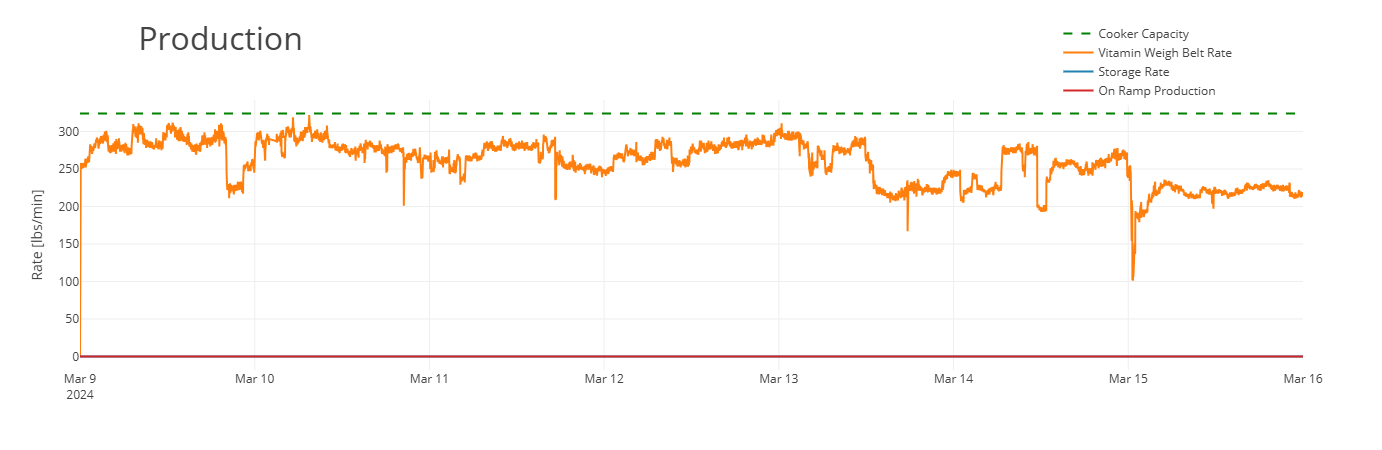
- Data shows cooker capacity often exceeds oven throughput — leaving unused potential.
The simulator visualizes:
- Green Line: Upstream cooker capacity
- Orange Line: Downstream oven output
System Configuration
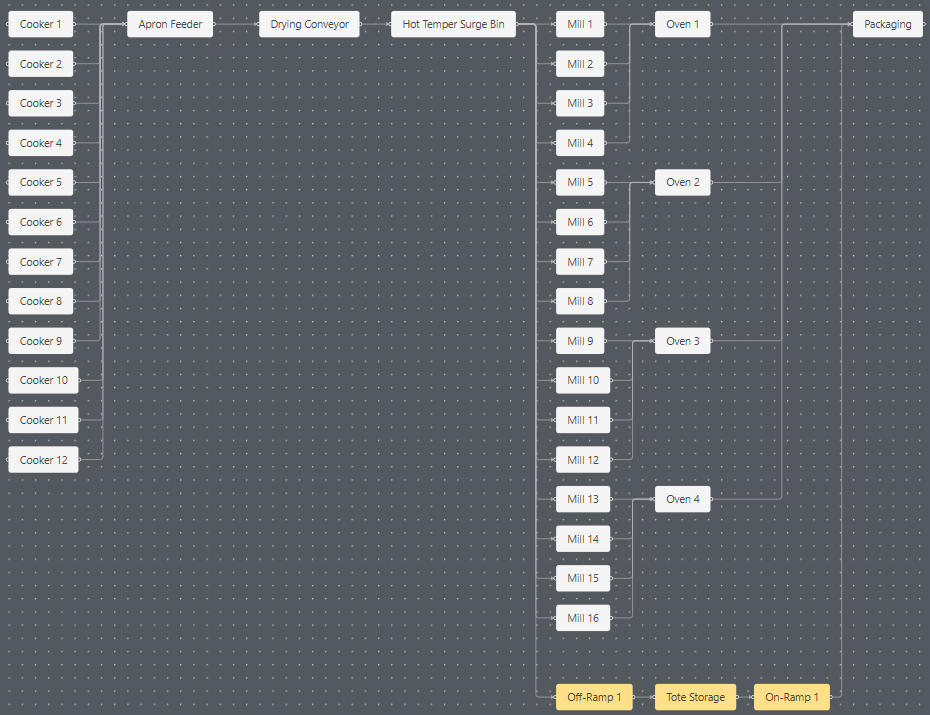
Production Flow
• 12 Parallel Cookers — hydrate and cook corn.
• Apron Feeder & Drying Conveyor — transfer and reduce moisture.
• Hot Temper Surge Bin — balances flow and provides buffering.
• 16 Mills → 4 Ovens — grind, toast, and finish product.
• Packaging — final stage of the process.

Decoupling Modules
The objective is to maximize cooker production by adding the decoupling capability yielding smarter flow control.
Off-Ramp: Removes excess flow when surge capacity is high, through a Dryer that stabilizes corn grit (~10–11% moisture).
Tote Storage: Stabilized corn grit is stored in totes. This effectively decouples the system.
On-Ramp: Feeds stored grit back into the line when packaging capacity is available.
How the Simulator Works
ReliaSim's Discrete Rate Simulation engine models the entire production flow using rate-based dynamics rather than individual units — the same physics that operators think in terms of: flow, downtime, and throughput.
This DRS-powered simulator:
- Runs annual production scenarios in seconds, not hours.
- Enables real-time scenario testing during meetings or coaching sessions.
- Uses decision-first modeling — start with the operational question, not a data-cleaning project.
User-controlled parameters:
- Number of off-ramp and on-ramp machines
- Tote Storage Capacity
- Ramp transfer rates and activation triggers
- Hot Temper Surge Bin capacity
- Planned downtimes and recovery rules
Outputs include:
- Profile of active Cookers
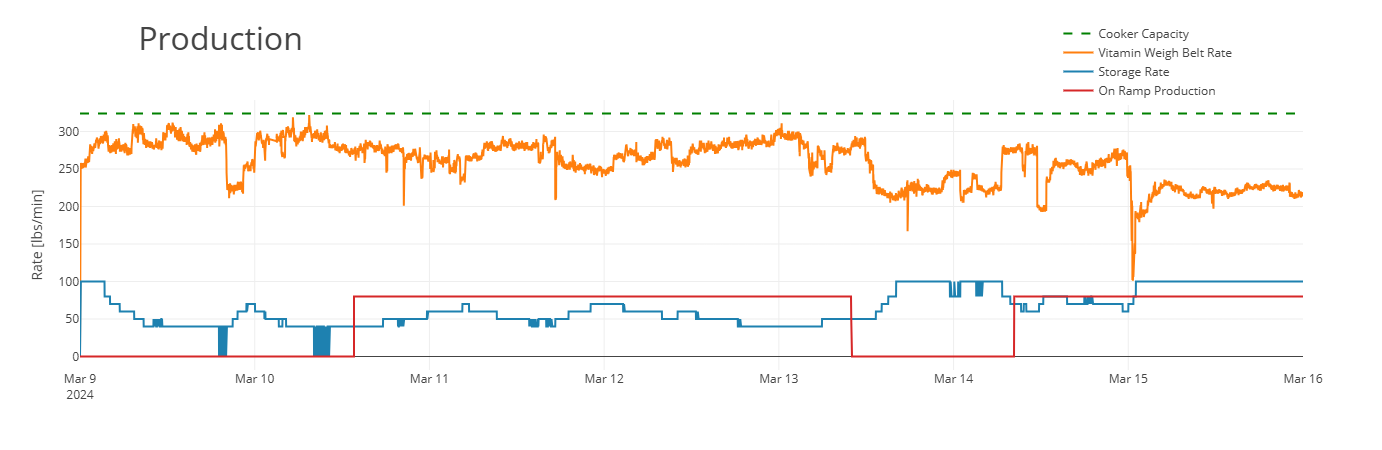
- Production curves: Cooker vs. oven throughput
- Packaging Load
- Hot Tempered Surge Bin Level and Tote Storage Inventory
- Efficiency and utilization metrics validated against actual data
Why ReliaSim + DRS Matter
Traditional simulation tools require specialists and take months to calibrate. ReliaSim compresses that into minutes, empowering engineers and plant managers to answer strategic questions during a meeting.
ReliaSim Advantages
- 1% efficiency accuracy validated against real production
- 1,200× faster than legacy discrete event tools
- Plant-manager accessible — no simulation expertise required
- Decision-first methodology that reveals hidden bottlenecks and counterintuitive improvements
DRS Foundation
- Models flow, not individual parts — perfect for cereal, chemical, and food operations
- Originally developed for modeling a multi-stage breakfast cereal plant, now rebuilt with modern data and speed
- Converts "What happened?" data into "What will happen if…?" predictive insight
Together, they transform simulation from a planning exercise into an operational decision tool for continuous improvement.
Key Insights
The Hot Temper Surge Bin acts as a dynamic buffer; right-sizing prevents cooker idle time.
The Off-Ramp Dryer preserves oversupply rather than wasting it.
The On-Ramp module converts stored product into extra throughput when capacity opens.
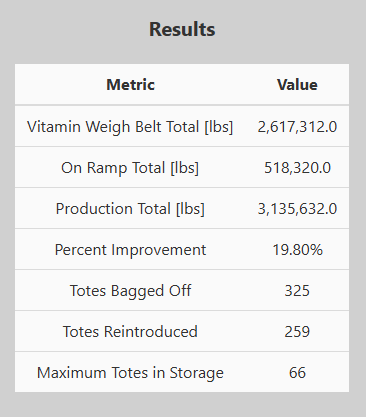
Proper configuration can increase effective production by 20% or more during key demand periods.
See the Simulator in Action
1-minute overview of how the simulator works
Checking access...